
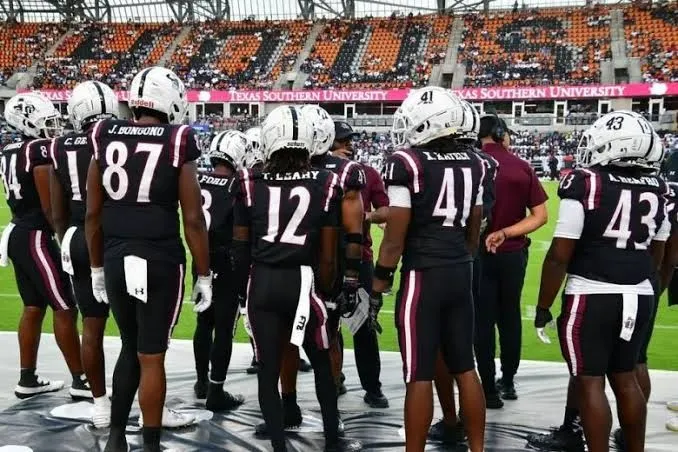
We’re approaching July, which is less than two months from the kickoff of the college football season when Texas Southern is scheduled to host North Carolina Central in the season opener on Aug. 29.
But where will the game be played exactly?
We don’t know because Texas Southern has yet to officially release its 2026 football schedule, which is normally out around April 15. Don’t worry, all of the opponents are lined up, and all of the games have been broken down by road and home games.
If you like this article, please consider donating to support the Defender →
The problem for TSU is that while Shell Energy Stadium is the Tigers’ home venue, the school and its stadium mates, the Dynamo soccer team, have a conflict on a few dates this upcoming season, starting with the season opener.
Shell Energy Stadium has been the co-home of the Houston Dynamo and Texas Southern football since 2012. Credit: Shell Energy
Additionally, SWAC home games against Southern on Oct. 17, Grambling State on Oct. 31, and Alabama State on Nov. 7 are in conflict with the Dynamo’s schedule. If you are doing the math at home, TSU is only going to get into Shell Energy Stadium for two out of six home games this season.
It’s not unreasonable that the primary resident, the Dynamo, gets dibs on Shell Energy Stadium. But it doesn’t seem right, and it definitely isn’t fair that Texas Southern was dealt this hand and left to deal with it on its own.
The language in the 30-year lease deal between the Dynamo and TSU and the Harris County Sports Authority states that the Dynamo has priority in scheduling during the regular season and postseason, but it’s unclear what TSU’s recourse is in the event of a conflict.
The agreement guarantees TSU a set number of home dates each year (typically up to 6 regular-season games). These dates are coordinated in advance around the MLS schedule to prevent direct, same-day game conflicts.
And if there is a late-season conflict arises, such as an unpredicted MLS playoff match or a nationally televised broadcast change, the contract stipulates cooperative rescheduling. Here are the options that are supposed to be explored.
-
Shifting TSU games to Thursday or Friday nights.
-
Utilizing early afternoon kickoff times to allow a multi-sport “doubleheader” on the same day.
-
Moving non-conference games to alternate Houston venues, such as NRG Stadium, if field transition times are physically impossible.
But right now, it doesn’t seem that any collaborative effort is being made, which can’t be what the Harris County Commissioners Court had in mind when it overwhelmingly voted to foot a big part of the bill for a soccer stadium that came with the condition that Texas Southern football would be the occupants for the Tigers’ home games. Now it feels almost as bad as the old days when TSU had to use a variety of venues around town because the Third Ward school didn’t have a viable on-campus stadium of its own.
Now again, Texas Southern has been scrambling for several months to find available high school football stadiums in the area that can host the four conflicting games and then foot the entire bill because the place they have a contract to play isn’t available.
Apparently, a couple of weeks ago, a 2026 football schedule was released to some alumni and boosters, but TSU officials say that schedule isn’t necessarily correct. In other words, some work still needs to be done on the deals that include the use of W.W. Thorne Stadium and Bulldog Stadium in La Porte.
Trying to find stadiums in the area with availability is beyond difficult because high school football isn’t just relegated to Friday Night Lights. Stadiums are booked all day Saturdays, too.
The bottom line is that, however you look at this, being at this point without a solid plan is a mess.
TSU shoulders some of the blame for not having all the clarity needed in this situation, and now the school is scrambling at this late stage of the game.
While Texas Southern coach Cris Dishman has made quips about how Shell Energy Stadium doesn’t feel like home, primarily because the football team is only permitted in on game days, he is taking the high road on this situation.
“We’re football coaches, and we’re going to coach football players,” Dishman said to The Defender recently. “It doesn’t matter whether it’s the backyard, Durley Stadium, or Emancipation Park. The games have to be played, and we’ve got to win the games.
“So I don’t care where we play or who we play, it’s about winning the games. So our guys are not going to feed into `We’ve got to play at this stadium or play at that stadium.’ It doesn’t matter where we play. We’ve got to win the games.”
Still, this can’t be a good look when recruits are weighing offers between TSU, with no on-campus stadium, and the possibility of playing some games at high school stadiums. Dishman says he isn’t concerned about looking bad in the eyes of recruits.
“It’s not ideal. It’s not what we wanted,” said Dishman, whose team did play Arkansas-Pine Bluff last season at Houston Christian University’s Husky Stadium. “But right now that’s our hand, and we’ve got to go where our hand is at. It doesn’t matter where you play.
“It’s not going to affect our recruiting because anybody who wants to come to Texas Southern is going to come to Texas Southern. They are going to come to Texas Southern because we have great coaches, and we are going to win games. That’s why you come to Texas Southern. You don’t come to Texas Southern for the facilities.”
The principals of this deal for the Harris County Sports Authority, Dynamo, and TSU have all since moved on. Attempts to reach Harris County Sports Authority and SWAC Commissioner Charles McClelland, who was the school’s athletic director in 2010, regarding TSU’s deal for stadium usage have been unsuccessful.
When I reached out to the Dynamo back in February, after I first learned that the World Cup was being played in Houston and that some other MLS changes had created a conflict with TSU, Dynamo Vice President of Communications and Corporate Affairs David Wiese-Carl responded with a vague email.
“We are actively collaborating with the leadership at Texas Southern University regarding the 2026 football schedule and will share more information once confirmed with the university,” he wrote.
But I did catch up with Texas Southern Board of Regents Chairman James Benham at a campus event the other night, and while he referred all questions about the Tigers’ home games to interim athletic director Dr. Paula Jackson, he was all too happy to discuss the Master Plan deal the board recently approved.
Included in this ambitious Master Plan, also known as Ascend 2030, is a new on-campus football stadium, which the Tigers desperately need. But how and when are complicated.
“It’s a matter of fundraising,” Beham said. “We’re taking fundraising very, very seriously right now. It’s all dependent on raising money.”
That is the issue that the alumni and boosters must solve, unless they want Texas Southern football to continue to lag behind FCS programs like Prairie View, which have nice shiny on-campus football stadiums.
The Board of Regents and President J.W. Crawford III have done the easy part by including the on-campus stadium in the plan to improve TSU.
“I think the board and the president spoke to how seriously we think it is when we approved the Facilities Master Plan that has a stadium on the facilities master plan,” Benham said. “That kind of said it all that we believe it’s important enough to quantify it into a public document that we voted on.”
Dishman is all on board.
“It’s very exciting,” he said. “That’s why we have to win more games and win more championships so that I can stay around and be a part of this Master Plan.”
But as of right now, TSU has a bad stadium situation that probably isn’t going to get better. What needs to happen is that Texas Southern needs clearer guidance on when conflicts arise and whether the Sports Authority or the Dynamo is responsible.
TSU shouldn’t be having to scramble alone to find stadiums to host its home football games this late in the season, especially when it isn’t the school’s fault.